Lice Eggs vs. Dandruff: A Parent’s Guide
If you found white or tan specks in your child’s hair and you’re not sure what you’re looking at, you’re not alone. Telling lice eggs vs. dandruff apart is one of the most common questions parents have, and getting it wrong in either direction has real consequences. Miss an active lice infestation and it spreads through the whole household. Panic over plain dandruff and you put your child through unnecessary treatment for nothing.
This guide will show you exactly what lice eggs look like, how dandruff compares, a simple at-home test you can do right now, and what to do if you still need a professional opinion. By the end, you will know how to tell lice eggs from dandruff with confidence.
What Are Lice Eggs (Nits)?
Lice eggs, commonly called nits, are laid by adult female lice directly onto the hair shaft. They are tiny, roughly the size of a pinhead or grain of sand, but they are visible to the naked eye under good lighting. Understanding what nits actually look like is the foundation of any lice eggs vs. dandruff comparison.
What Do Lice Eggs Look Like?
Nits are oval or teardrop-shaped with a small cap at the top where the louse will eventually hatch. Their color depends on whether they have hatched yet. Viable nits that have not hatched are typically tan, yellow, or light brown. Empty nits that have already hatched turn white or translucent, which is why many parents spot white specks and assume dandruff when they are actually looking at empty nit casings from an active or recent infestation.
Where Are Lice Eggs Found in the Hair?
Location is one of the most reliable ways to identify nits. Lice lay their eggs close to the scalp, usually within a quarter inch of the root, where body heat helps them incubate. You will find them most often behind the ears, at the nape of the neck, and along the crown of the head. Specks appearing farther down the hair shaft are likely older or empty casings that have grown out over time.
Most importantly, nits are cemented to the hair strand with a glue-like substance the louse produces. They do not move. They do not slide. They do not brush off. That single characteristic, how firmly a speck is attached to the hair, is the fastest way to distinguish lice eggs from dandruff or anything else.
What Does Dandruff Look Like in Hair?
Dandruff is dead skin shedding from the scalp. It is extremely common, not contagious, and has nothing to do with hygiene. Because dandruff and lice eggs are both small, white, and found in the hair, they cause a lot of confusion for parents doing a first check at home.
Dandruff flakes are irregular and flat with no consistent shape. They sit loosely on the scalp surface or rest on the hair without any real attachment. The defining characteristic of dandruff is that it falls off the moment you touch it. Flick the strand, run a finger through the hair, or give it a light brush and dandruff disappears immediately. That ease of removal is the clearest difference when comparing dandruff vs. lice eggs.
Nits vs. Dandruff: The Key Differences
When it comes to nits vs. dandruff, four things tell them apart: attachment, location, shape, and pattern.
Attachment is the most reliable indicator. Nits are firmly cemented to the hair shaft and require a fingernail or fine-tooth comb to remove. Dandruff is loose and falls away with almost no effort.
Location differs as well. Nits appear on the hair shaft itself, clustered close to the scalp in specific spots: behind the ears, the nape of the neck, and the crown. Dandruff sits on the scalp surface or scatters randomly through the hair with no particular pattern.
Shape is another giveaway. Nits have a consistent oval or teardrop form with a visible cap at the top. Dandruff flakes are irregular, flat, and have no defined shape.
Pattern matters too. Finding specks concentrated behind both ears and at the nape of the neck is a classic early sign of lice. Dandruff has no clustering pattern and tends to distribute evenly across the scalp.
How to Tell Lice Eggs from Dandruff: The Pull Test
You do not need a special tool to get a first answer at home. The pull test is fast, free, and gives you a strong initial read on whether you are looking at lice eggs or dandruff.
Part the hair and find a speck close to the scalp. Pinch the hair strand just below it and try to slide it down and off the strand with your fingernail. If the speck falls away or moves easily, it is likely dandruff, debris, or product buildup. If it grips the strand and will not budge without real effort, that is a strong sign you are looking at a nit.
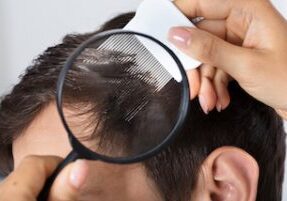
For a more thorough check, use a fine-tooth lice comb under bright natural light or a flashlight. Work section by section from the scalp outward, starting behind both ears and across the nape of the neck. Nits will either stay stuck to the hair strand or transfer onto the comb while still visibly attached. Dandruff will scatter or disappear entirely.
Other Things That Can Look Like Lice Eggs
Dandruff is not the only thing mistaken for nits. A few other common culprits cause false alarms for parents doing a home check.
Hair Casts
Hair casts are white, tube-like sheaths that wrap around the hair shaft and can look like nits at a glance. The difference is easy to spot: hair casts slide freely up and down the strand when touched. A nit will not move at all.
DEC Plugs
DEC plugs are waxy deposits from the scalp’s sebaceous glands. They can stick to the hair shaft but are softer and less uniform than a nit. They tend to smear when you try to remove them rather than holding a defined shape.
Hairspray and Product Buildup
Dried hairspray and styling product residue can flake into small white or yellowish specks that stick to hair. These are usually irregular in size, lack the consistent teardrop shape of a nit, and will crumble or break apart when handled. In all of these cases, the pull test still applies. True lice eggs are firmly attached, oval-shaped, and consistent in appearance. If it slides, smears, or crumbles, it is not a nit.
What to Do If You Find Lice Eggs
Finding a nit, or something that looks like one, does not mean your child has a full-blown infestation. Stay calm and work through it systematically.
Do a full head check under good lighting before drawing any conclusions. Focus on the areas where lice prefer to lay eggs: behind the ears, the nape of the neck, and the crown. Check other family members too. Lice spread through direct head-to-head contact, so if one child has them, siblings and parents need to be checked as well.
If you are finding specks that pass the pull test, firmly attached and oval-shaped close to the scalp, and you want a definitive answer before starting treatment, a professional lice check is the fastest path to certainty. At Lice Knowing You, our technicians can confirm in minutes whether you are dealing with lice eggs or something harmless, and if treatment is needed, we can take care of it the same day.
Frequently Asked Questions About Lice Eggs vs. Dandruff
Can You Have Nits Without Live Lice?
Yes. It is possible to find nit casings without finding live lice. This can happen after a recent treatment that killed the adult lice but left behind empty shells, or in the very early stages of an infestation before lice have had time to multiply. Finding nits without visible live lice does not mean you are in the clear. It still warrants a thorough check and often a professional evaluation to confirm.
Do Dead Nits Fall Out on Their Own?
No. Empty and dead nit casings stay glued to the hair shaft even after the louse has hatched or died. They do not fall out on their own and must be physically removed with a fine-tooth lice comb. This is why manual combing is an essential part of lice treatment, not just an optional step.
How Long Do Lice Eggs Take to Hatch?
Lice eggs take about 8 to 10 days to hatch. After hatching, the nymph takes another 9 to 12 days to reach adulthood and begin laying eggs of its own. This lifecycle is why lice treatment typically requires a follow-up check or second treatment around 7 to 10 days after the first, to catch any newly hatched lice before they can reproduce.
Can Dandruff Look Exactly Like Nits?
At a quick glance, sometimes yes. Both are small, white, and found in the hair. But under close inspection and with the pull test, the differences become clear fast. Dandruff falls off with almost no effort. Nits do not. If you are finding white specks that stay put no matter how many times you try to brush them away, do not assume it is dandruff. Get a professional opinion before writing it off.
Still Not Sure? Get a Professional Lice Check.
Telling lice eggs from dandruff on your own is not always easy, especially if this is the first time you have dealt with it. The good news is you do not have to guess. A professional lice check takes the uncertainty out of the equation completely.
At Lice Knowing You on Mercer Island, our technicians are trained to identify nits vs. dandruff quickly and accurately. We serve families across the greater Seattle area and can confirm what you are dealing with in a single visit. If treatment is needed, we handle that too, same day, no stress.